← Back to All Guides
A free guide by Lauren Dallas Instagram
The Niche Math That Made Me Millions
Everyone assumes a bigger audience means bigger money. It doesn't. Here's the actual math behind why a smaller, tighter niche can out-earn a broad one by 50x on the exact same $97 product — and how to know if the niche you're circling is one of them.
More competitors isn't the real risk. More competitors chasing the same small pool of ready-to-buy people is.
Most people pick a niche by how big the audience looks, not by how many other people are already selling to it. That's backwards. A niche with 10,000 people in it sounds bigger than one with 1,000 — until you realize 1,000 other creators are also fighting for that same 10,000, and almost nobody is fighting for the smaller pool.
Step 1
Run The Numbers Before You Decide Anything
Here's the actual math: a broad niche with 10,000 potential buyers and 1,000 competitors, converting at 10 sales each on a $97 product, nets $970 per seller. A tight subniche with only 1,000 potential buyers but just 2 competitors, converting at 500 sales each on the same $97 product, nets $48,500 per seller. Same product. Same price. The only thing that changed is how many other people were splitting the pool.
Quick Test
Take your audience size and divide it by the number of people already selling to that exact audience. If that number is small, you're not differentiated — you're just one more voice in a crowd.
Step 2
Look For High Demand And Low Supply
The niches worth building in aren't the biggest ones — they're the ones where people are actively searching for a solution and almost nobody has built one for them yet. "Personal finance" is enormous and saturated. "Personal finance for freelancers who hate spreadsheets" is small, specific, and nearly empty.
Reality Check
If you can Google your product idea and get 50 million results, that's not a niche — that's a marketplace you're trying to out-shout.
Step 3
Make Sure It's Actually Sellable, Not Just Interesting
A profitable niche solves a real problem, not a "nice to have." There's a difference between optimisation and transformation — "saves you 10 minutes a day" is optimisation. "Gets you your first client" is transformation. People pay for transformation, not convenience.
Quick Definition
Transformation = a before/after people would tell their friends about. Optimisation = a minor improvement nobody brags about. Aim for the first one.
Step 4
Price It To Match Where You Actually Are
Your price needs to match your current level of credibility, not your ambition. A $970 product from someone with zero proof is a much harder sell than a $97 product from someone in exactly the same position — start where the trust actually is, and raise the price as the proof builds.
Real Talk
You Don't Need A Bigger Audience. You Need The Right One.
Getting the math right is step one, and now you have it. But if you want to skip the guesswork entirely — no spreadsheets, no "is this the right niche" spiral — that's exactly what I walk through live in the training below, including the AI tool that validates your niche and product opportunity for you before you build a single thing.
Free Training
Learn How I Made $10.5K In 4 Days From A Brand New Instagram Account
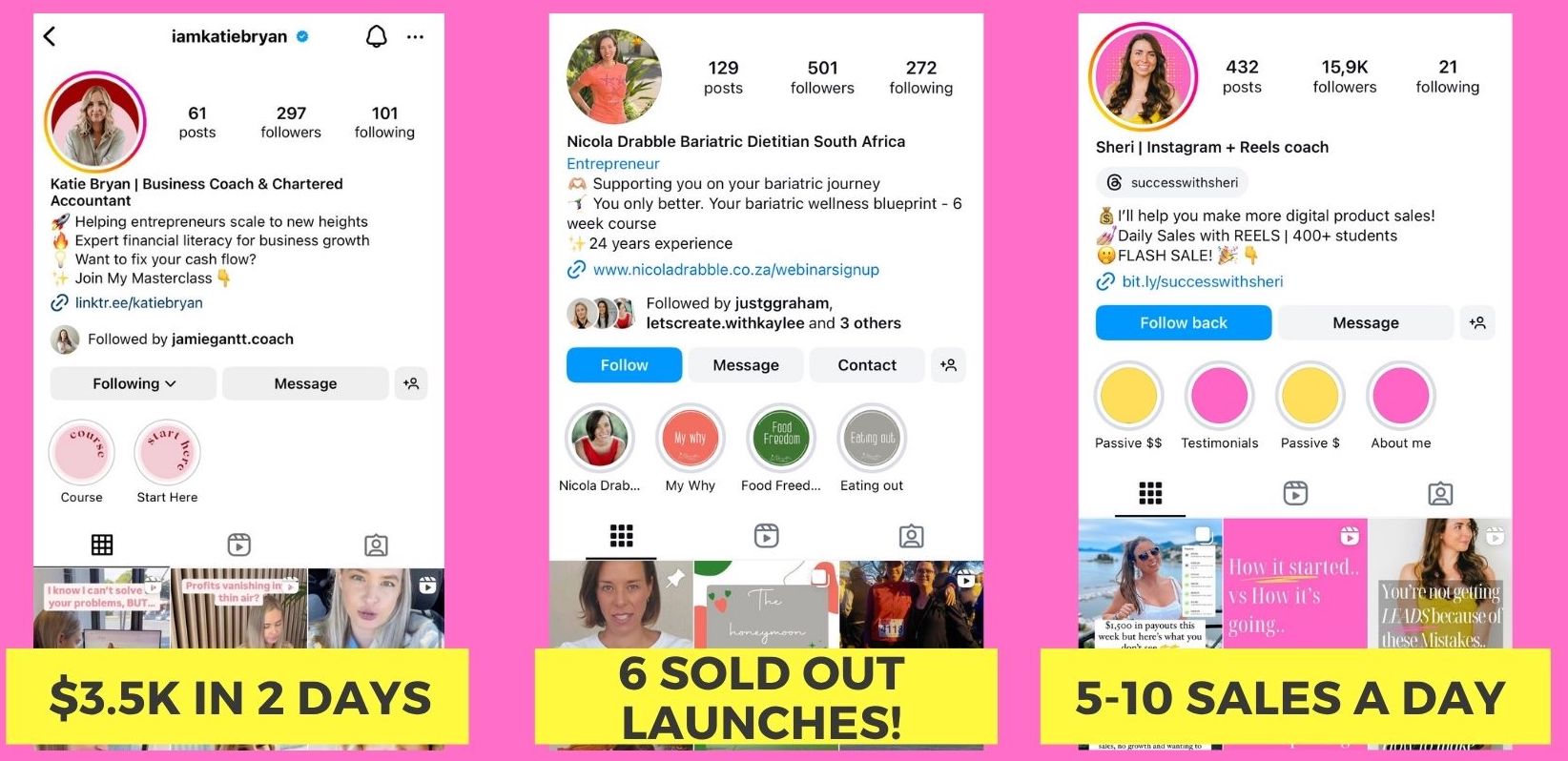
The exact system you can copy to make daily sales with a digital product. A free live training revealing the steps that have helped complete beginners make $3.5K in 2 days, $18K in a first launch, and $185K in 6 months — without a big following, paid ads, or hours of daily content.

Real Results ★
You don't need a big following to get big results